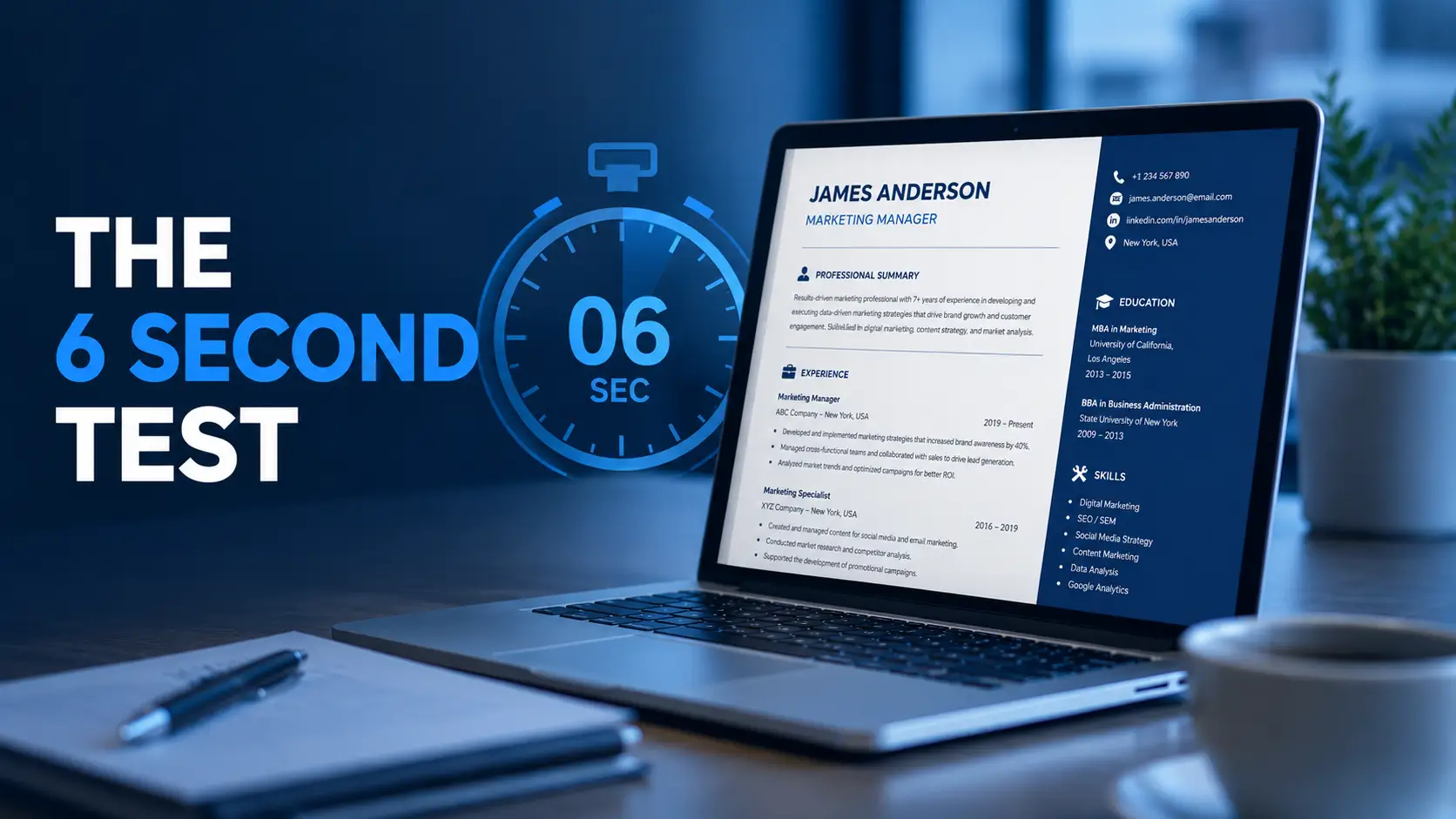
The 6-Second Resume Test: What Recruiters Look at First
Key Takeaways
- The 6-second resume test refers to eye-tracking research showing that recruiters spend an average of just 6 to 7 seconds on the initial scan of a resume before deciding whether to keep reading.
- During that window, roughly 80% of a recruiter's attention concentrates on six data points: name, current title, current employer, employment dates, previous title, and education.
- The claim traces back to a specific, named 2012 study by TheLadders, not a vague "research shows." Later research updated and expanded on it, and this guide covers both.
You've probably heard some version of the "6-second rule" for resumes. It's real research, not an urban legend, but the way it usually gets repeated leaves out where it came from and what it actually measured. Here's the origin, what it means for your resume, and a self-test you can run on your own right now.
What Is the 6-Second Resume Test?
The 6-second resume test describes the initial screening pass a recruiter makes on a resume, an ultra-fast visual scan (not a full read) used to decide whether a candidate looks relevant enough to warrant a closer look. It's less about reading and more about pattern-matching: name, title, company, and dates register almost instantly, while everything else waits for a second pass, if the resume earns one.
Where the 6-Second Claim Actually Comes From
The number comes from a specific, dated source: a 2012 eye-tracking study by the career site TheLadders, which monitored 30 professional recruiters over a 10-week period as they reviewed resumes. The average initial screen came out to 6 seconds.
TheLadders later updated the research in 2018 with a larger sample, and the average had grown slightly to 7.4 seconds. Both figures describe the same thing: an initial fit-or-no-fit filter, not the total time a resume gets once it clears that filter. Resumes that pass this first scan generally receive several more minutes of attention during a proper review.
More recent research adds further texture. A newer study covering 4,289 resume reviews found the average first pass ran closer to 11.2 seconds when recruiters used AI-assisted screening tools that display job context alongside the resume. Separately, a 2025 experiment led by Jerry Lee of Wonsulting used hidden eye-tracking equipment during live resume reviews and produced some of the most detailed heat map data available, largely confirming the same F-shaped scanning pattern the original TheLadders research documented.
Whichever exact number you land on, the practical takeaway hasn't changed since 2012: you have single-digit seconds to make the case for a closer read, and that case is made almost entirely by formatting and placement, not by paragraphs of detail.
The Six Data Points Recruiters Actually Look For
Across the original research and its follow-ups, the same six pieces of information consistently absorb the bulk of a recruiter's attention during the initial scan:
- Your name
- Current (or most recent) job title
- Current (or most recent) employer
- Employment dates for your current role
- Previous job title
- Education
If any one of these is hard to find, buried in the middle of the page, or missing entirely, the scan effectively stalls before it gets anywhere near your bullet points.
How Recruiters' Eyes Move: The F-Pattern
Eye-tracking heat maps consistently show recruiters don't read a resume top to bottom. They follow something closer to an F-shaped pattern: a horizontal sweep across the top of the page, then a vertical scan down the left margin, with a shorter second horizontal sweep somewhere around the middle.
The practical effect is that the top third of your resume, especially the top-left, gets the overwhelming majority of visual attention. Content on the right side of the page or lower down the document is much more likely to be skipped entirely during this first pass, regardless of how good it is.
This is also why dense paragraphs tend to get skipped over. An eye moving quickly down the left margin jumps from one structural element (a heading, a bold title, a bullet) to the next, and a wall of unbroken text simply doesn't offer anywhere for the eye to land.
Run Your Own 6-Second Test Right Now
Here's a version of the test you can actually run on your own resume in the next minute.
- Open your resume full-screen so nothing else is visible on the page
- Set a timer for 6 seconds, or have someone else do this step for you
- Look at the resume for those 6 seconds, then look away and write down everything you remember: the name, the title, the most recent company, and anything else that stuck
- Compare what you wrote down to what actually matters most. Did your strongest credential make the list? Did your current title come through clearly? Was there anything you didn't notice that should have been front and center?
- If your best material didn't register, move it. The fix is almost always about placement, not content. Your strongest information needs to sit in the top third of the page, left-aligned, not buried in a summary paragraph or the second half of your work history
Run this two or three times with a day between attempts, since your own familiarity with the document can make it easier for you to "see" things a stranger wouldn't.
Phrases and Formatting Choices That Actively Hurt the Scan
A handful of habits consistently work against a fast, favorable scan, even when the underlying experience is solid.
Phrases that trigger skepticism:
- Self-proclaimed descriptors like "expert," "visionary," or "exceptional"
- Overused clichés such as "team player," "detail-oriented," or "proven track record"
- Passive constructions like "was responsible for overseeing" instead of a direct action verb
- Filler openers like "duties included," which describe a job posting, not an accomplishment
Formatting choices that break the scan:
- Dense paragraphs of four or more lines with no breaks
- Multi-column layouts, which fracture the natural F-pattern reading order
- Centered or right-aligned content, since the eye's vertical scan runs down the left margin
- Objective statements or "references available upon request," both of which take up prime top-of-page space without earning it
When structuring resumes for clients to lead with their strongest signals, the biggest single fix is almost always the same: move the best material higher and to the left, and cut anything sitting in that prime real estate that isn't doing real work.
How to Structure Your Resume for the Scan
A few structural choices consistently support a faster, more favorable first pass:
- Use a reverse-chronological format unless you have a specific reason not to. It's what recruiters expect, and it puts your most recent, most relevant experience first
- Front-load your current role. The first bullet point under your most recent position tends to get more attention than everything in the bottom half of the resume combined
- Keep bullets to one or two lines. Anything longer starts to read like a paragraph and gets treated like one. Tailoring your resume to each job also helps your strongest bullets land in that first scan
- Quantify wherever possible. Numbers act as visual anchors that catch the eye mid-scan in a way plain text doesn't
- Left-align everything. Titles, companies, and dates should all sit where the vertical scan actually travels
Quick Tips
- Keep your resume to one page unless you have 10+ years of directly relevant experience
- Use a standard, readable font at 10 to 12pt for body text
- Make sure your name and current title are the first things visible on the page, not competing with a photo, icon, or decorative header
- Save formatting checks for after content is finalized. It's easier to trim a strong draft than to polish a weak structure
Frequently Asked Questions
Is the 6-second resume rule real, or is it a myth?
The underlying research is real: a 2012 TheLadders eye-tracking study documented an average initial screen of 6 seconds, later updated to 7.4 seconds in 2018. What's misleading is the common interpretation that your entire resume gets exactly 6 seconds total. It's the length of the initial filter, not the ceiling on total attention a resume that passes it will receive.
What resume format is best for passing a quick scan?
A reverse-chronological format with a single column, standard section headings, and left-aligned content works best. This matches both what recruiters expect to see and how the eye naturally scans the page, and it also tends to be the easiest format for ATS software to parse correctly.
How do I make my resume easier to skim?
Keep bullet points short (one to two lines), lead with strong action verbs, quantify results wherever you can, and make sure your name, current title, and most recent employer are immediately visible in the top third of the page without any hunting required.
Does my resume get read in full if it passes the 6-second scan?
Not immediately, but it earns a much longer look. Research suggests resumes that clear the initial scan receive several more minutes of attention during a proper review, compared to the single-digit seconds spent on the first pass.
What are recruiters actually looking for during those first seconds?
Primarily relevance: does your current or most recent title match what they're hiring for, is the employer recognizable enough to provide context, and do your employment dates look reasonable without unexplained gaps. It's a fast pattern-match, not a detailed evaluation.
Does this apply even if my resume passes an ATS scan first?
Yes. Passing an ATS is a separate hurdle from the human scan that follows it. A resume can be technically well-optimized for keyword matching and still lose a recruiter's attention in the first few seconds if the layout doesn't guide their eye to the right information. Our free ATS Resume Checker can tell you whether the software side is in good shape (our guide on beating the ATS without keyword stuffing explains how that side works), but the structure covered in this guide is what wins the human read that comes next.
If you'd rather have someone else build a resume engineered for both the ATS and the 6-second human scan, our team writes resumes by hand for exactly this. Take a look at our resume writing service if you'd like the structural work done for you.