

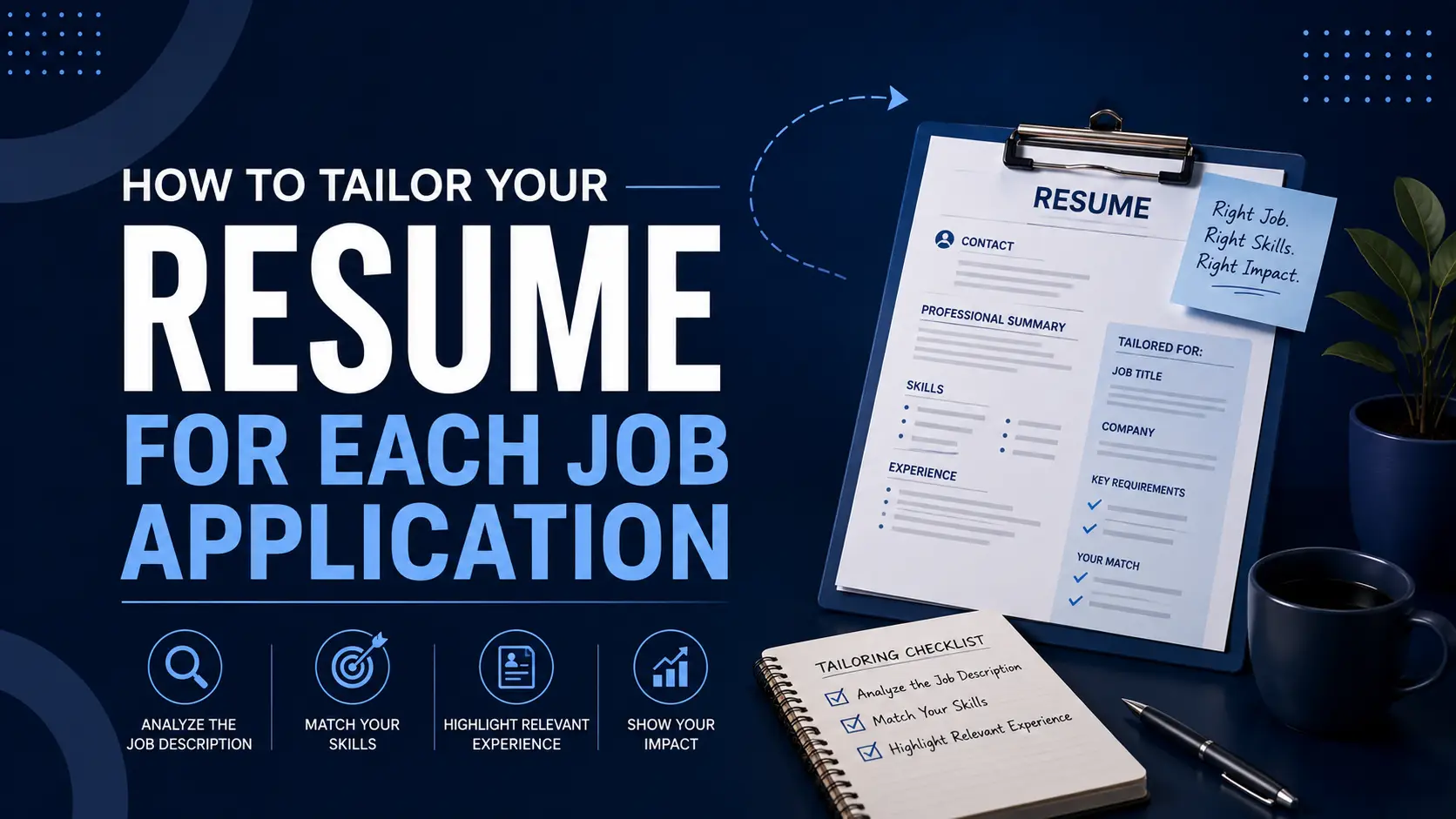
How to Tailor Your Resume for Each Job Application
Key Takeaways
- Build one comprehensive master resume that holds everything you've ever done, then make fast, targeted edits to it for each application rather than starting from scratch every time.
- Five elements do most of the work when tailoring: your headline or title, your summary, your skills section, your bullet order, and the specific wording inside your top bullets.
- A quick tailoring pass takes about 5 to 10 minutes. Save a deeper 20-minute pass for the roles you want most.
Sending the exact same resume to every job is one of the most common reasons applications go nowhere. Tailoring isn't about rewriting your whole resume each time. It's about building one strong base document once, then making a handful of fast, targeted edits so each version speaks directly to the role in front of you.
What Does It Mean to Tailor a Resume?
Tailoring a resume means adjusting its wording, emphasis, and order so it closely matches a specific job posting, rather than sending an identical, generic version to every employer. It's the difference between a resume that says "I've done a lot of things" and one that says "I'm the right person for this exact role."
Recruiters and applicant tracking systems both reward this. ATS platforms rank resumes by how closely they match a posting's language, and recruiters consistently favor resumes that clearly speak to the role they're hiring for over resumes that read like a general career summary.
Build a Master Resume Once, Tailor Fast Every Time
A master resume is a single, comprehensive document that holds every job, bullet, skill, and accomplishment you have, without worrying about length or relevance to any one posting. You never send this version to an employer. It's your source material.
Building one changes the entire tailoring process. Instead of writing new content for every application, you're selecting and lightly rewording from a pool you've already built. This is the single biggest time-saver in the whole process, and it's the difference between tailoring taking five minutes and tailoring taking an hour.
To build yours:
- Collect everything. Every role, every bullet you've ever written, every certification, every skill, even ones you haven't used in years
- Don't trim yet. The master resume is meant to be too long to send as-is. That's fine, since trimming happens per application
- Organize by role and skill, not just chronologically, so you can quickly find relevant bullets when a job posting calls for a specific skill set
From there, every application becomes a subtraction and reordering exercise, not a rewriting one. When helping clients tailor resumes across multiple applications, this is consistently what separates people who can realistically apply to a dozen roles a week from people who burn out after three.
The 5 Elements That Actually Matter When Tailoring
You don't need to touch every line of your resume for each application. Focus your time on these five elements, in this order of impact:
- Headline or title. If the posting says "Senior Growth Marketer" and that's an accurate description of your role, use that exact phrase rather than a looser variation
- Summary. Rewrite the opening line or two to speak directly to what this specific posting is asking for, using two or three of its own key terms
- Skills section. Move the skills the posting lists as requirements to the front, and drop anything irrelevant to this particular role
- Bullet order. Within each role, move your most relevant bullets to the top. The first bullet under your most recent job gets read more closely than anything below it
- Bullet wording. Adjust the specific language in your top few bullets to mirror terminology from the posting, without changing what actually happened
Everything else on your resume, older roles, education, certifications, generally stays as-is between applications.
A Time Budget: Quick Pass vs. Deep Pass
Not every application deserves the same level of effort, and treating them all identically usually means either wasting time on roles you're lukewarm about or under-investing in the ones you actually want.
Quick pass (5 to 10 minutes), for most applications:
- Swap the headline to match the job title
- Rewrite the first line of your summary
- Reorder your skills section around the posting's requirements
- Move your strongest, most relevant bullet to the top of your most recent role
Deep pass (15 to 20 minutes), for your top-priority roles:
- Everything in the quick pass, plus
- Reword the top two or three bullets in each of your last two roles to mirror the posting's specific language
- Adjust section headings if the industry calls for it, for example turning "Work Experience" into "Research Experience" for an academic or research-heavy posting
- Read the job description twice, once for keywords and once for what it's not saying, like team size, tools, or pace of work that hint at priorities the posting doesn't spell out directly
For a deeper breakdown of exactly which keywords carry the most weight and where to place them, see how to beat the ATS without keyword stuffing.
Finding and Using the Right Keywords
The job posting itself is your best source for what to change. Read it with two questions in mind: what shows up more than once, and what sits under "requirements" versus "preferred" or "nice to have."
- Repeated terms are almost always worth including, since both ATS software and human readers register repetition as a signal of priority
- Required qualifications matter more than preferred ones, and are more likely to function as an automatic filter
- Tool and software names should be used exactly as written in the posting rather than swapped for a generic description
- Soft skills mentioned by name, like "cross-functional collaboration" or "fast-paced environment," are worth echoing if they genuinely describe how you work, not just because they appeared in the listing
The goal is matching relevance, not stuffing every keyword you can find into every section. A resume that reads like a copy-paste of the job posting reads just as poorly to a recruiter as one that ignores it entirely.
A Before-and-After Example
Here's what tailoring actually looks like applied to a single bullet, rather than in the abstract.
Generic version (same for every application): "Managed marketing campaigns and increased leads."
Tailored for a posting emphasizing B2B lead generation and HubSpot: "Led B2B email marketing campaigns using HubSpot, increasing qualified leads by 24% in Q3."
Nothing about the underlying accomplishment changed. What changed is specificity: the tools, the audience, and the metric now mirror exactly what this particular posting is asking for, which makes the connection between your experience and their need immediate instead of implied.
What to Avoid When Tailoring
- Don't fabricate skills or experience just because a posting asks for them. Unmatched keywords are a smaller problem than claims you can't back up in an interview
- Don't delete sections just because they don't look directly relevant. A skill that isn't explicitly required can still be a transferable strength worth keeping, especially for a career change
- Don't rewrite your entire resume from scratch for every application. That's what the master resume and the quick-pass system exist to prevent
- Don't repeat the same phrase excessively to force a keyword match. One or two well-placed instances read better than five forced ones
Quick Tips
- Keep a copy of every job posting you apply to, saved as a file rather than just a bookmark, since listings get taken down
- Update your LinkedIn profile whenever you significantly update your master resume, so the two stay consistent (or let our LinkedIn Optimization service handle it)
- If two postings are nearly identical, it's fine to reuse the same tailored version rather than starting over
- Proofread after tailoring, not just after writing. Swapped keywords are a common source of small, easy-to-miss errors
Frequently Asked Questions
Is it bad to use the same resume for every job application?
Sending an identical resume everywhere significantly lowers your response rate compared to a lightly tailored version. You don't need a completely different resume per role, but updating the headline, summary, skills order, and top bullets makes a real difference in how well your resume matches what a recruiter or ATS is looking for.
How much time should I spend tailoring my resume?
A quick pass covering the headline, summary opener, and skills reorder takes about 5 to 10 minutes and is enough for most applications. Save a deeper 15 to 20 minute pass, which also reworks your top bullets, for the roles you're most serious about.
What parts of a resume should I actually change for each application?
Focus on five elements: your headline or title, your summary's opening lines, your skills section order, the order of your bullets within each role, and the specific wording in your top two or three bullets. Older roles, education, and certifications generally don't need to change between applications.
What's the difference between a master resume and a tailored resume?
A master resume is a comprehensive document holding every job, skill, and accomplishment you have, used only as source material and never sent to an employer. A tailored resume is the trimmed, reordered version built from that master resume for one specific application.
Is matching keywords the same thing as keyword stuffing?
No. Keyword matching means using a posting's own terminology naturally within real accomplishments you already have. Keyword stuffing means repeating terms excessively or listing skills you don't actually have just to trigger a match, which tends to backfire with both ATS software and human readers.
Should my cover letter be tailored too?
Yes, ideally to the same degree as your resume. Our Cover Letter Writing service writes each letter around a specific job posting, and our guide to career-change cover letters shows what that looks like in practice. A tailored resume paired with a generic cover letter, or the reverse, tends to undercut the effort you put into the other document.
Once your resume is tailored, it's worth a final check on whether it's actually built to pass automated screening. Our free ATS Resume Checker scores it against a detailed rubric right in your browser, and if you'd rather have your master resume built by a professional from the start, our resume writing service can handle that too.