How to List Volunteer Work on a Resume (With Examples)
Key Takeaways
- Volunteer work belongs in one of three spots on a resume your professional experience section, a dedicated volunteer section, or your summary depending on relevance and how much paid experience you already have.
- Format every entry like a job: role, organization, location, dates, and one to two accomplishment-focused bullets.
- Volunteer experience carries the most weight for recent grads, career changers, and anyone bridging an employment gap.
Volunteer work is real experience, and most hiring managers treat it that way. The question isn't whether unpaid work "counts" it's where it goes on the page and how you write it so it reads like the rest of your resume instead of an afterthought.
Should You List Volunteer Work on Your Resume?
Yes, in most cases. List volunteer work whenever it demonstrates a skill the employer is screening for, fills a gap in your paid history, or supports a career change. What matters to a hiring manager is what you did and what it produced not whether you were paid to do it.
That said, volunteer work is optional, not mandatory. It earns a place on your resume when:
- You're a recent graduate or student with limited paid work history
- You're changing careers and need to show relevant skills you haven't used in a paid role yet
- You have a gap in your employment history you'd rather explain than leave blank
- The role targeted specific, checkable skills event planning, fundraising, tutoring, project coordination that map directly to the job description
- You're applying somewhere that visibly values community involvement, such as a nonprofit, school, or mission-driven company
It's worth leaving off when your paid experience already fills the page with more relevant material, or when the volunteer role is old enough that it no longer reflects your current skill set. In our own work writing resumes for clients, the volunteer section is almost always the first thing we trim once someone has three or more solid years of directly relevant paid experience.
Where to Put Volunteer Work on a Resume: 3 Placement Options
Placement depends on two things: how relevant the work is to the job you want, and how much paid experience you're competing with. There are three reliable spots.
Option 1: Inside Your Professional Experience Section
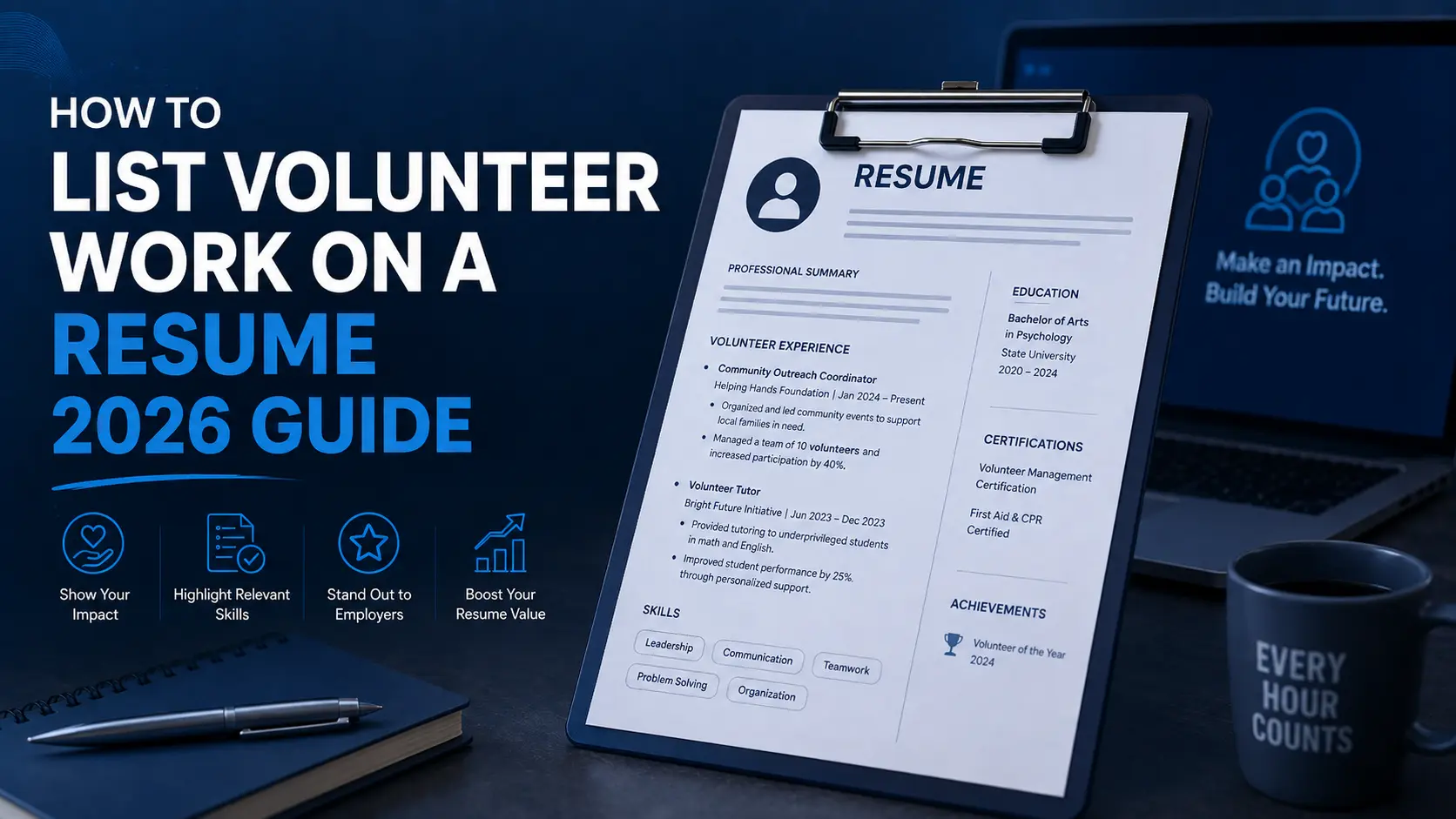
Use this when the volunteer role is directly relevant to the job, or when you don't have enough paid experience to fill the section on its own. Format it exactly like a paid job, and add "Volunteer" to the title so it's unmistakable:
Volunteer Marketing Coordinator
Riverside Youth Center — London, United Kingdom | Mar 2024–Present
- Built a content calendar that grew the center's donor newsletter list by 40%
- Trained 6 new volunteers on the center's outreach and scheduling tools
Option 2: In a Dedicated "Volunteer Experience" Section
Use this when the work is worth mentioning but isn't your strongest, most relevant material. It goes after your professional experience and education, and it can be formatted more briefly than a full job entry often just a title, organization, and one line.
Option 3: In Your Resume Summary or Skills Section
If a single volunteer role is the clearest proof you have of a specific skill, mention it in your summary in one sentence, or drop the skill itself into your skills list. This works well when the volunteer work is your single strongest piece of evidence for a requirement in the job posting, but doesn't warrant its own section.
How to Format a Volunteer Entry (The Exact Structure)
Whichever section you choose, use the same five pieces of information every time:
- Role or title — use the actual title, or a short, accurate one if none existed ("Event Volunteer," "Intake Assistant")
- Organization name
- Location — city and country/state is enough
- Dates — month and year, or year alone if that's all you have
- One to two bullets — what you did and what resulted from it, written the same way you'd write a paid-job bullet: action verb, task, outcome
Here's a complete example built to that structure:
Volunteer Event Coordinator
Green Valley Food Bank — Delhi, India | Jun 2023–Jan 2024
- Coordinated 12 monthly food distribution events serving 300+ households
- Recruited and scheduled a rotating team of 20 volunteers using a shared calendar
Listing Volunteer Work With No Formal Title or No Exact Dates
If the organization never gave you an official title, write a short, accurate one that reflects what you actually did "Volunteer Tutor" or "Community Outreach Volunteer" rather than leaving the line blank. Recruiters read titles first, so an honest, descriptive one does more work than no title at all.
For dates, a year alone ("2023–2024") is acceptable if you genuinely can't recall exact months. What you shouldn't do is guess at specific dates you're not sure of if an employer asks for verification later, inaccurate dates raise more questions than a rounded year ever would.
Using Volunteer Work to Explain an Employment Gap
Volunteer work is one of the most natural ways to account for time away from paid employment whether that's a period of job searching, caregiving, relocation, or study. Place it directly in your work history, in reverse chronological order alongside your paid roles, rather than tucking it into a separate section at the bottom. That placement keeps your timeline continuous instead of drawing attention to a blank stretch.
The key is treating the gap-filling role with the same level of detail as a paid job organization, dates, and results so it reads as active contribution rather than a placeholder.
When to Leave Certain Volunteer Work Off Your Resume
Not every volunteer role belongs on paper. Roles tied to a religious congregation, a political campaign, or an advocacy group can reveal personal beliefs you'd rather not put in front of a hiring manager before you've even had an interview even where discrimination on that basis is illegal, it's difficult to prove and easy to avoid entirely.
A simple test: if the organization's name alone signals a religious affiliation, political stance, or cause a reasonable employer might have strong feelings about, either leave it off or describe the work generically (e.g., "Community organizing volunteer" instead of naming the specific group) unless the specific affiliation is clearly relevant to the job.
Will an ATS Actually Read Your Volunteer Section?
Yes, an applicant tracking system parses your volunteer section the same way it parses everything else on the page: as plain text under whatever heading you give it. That means two things matter more than most people realize.
First, use a standard section heading. "Volunteer Experience" or "Volunteer Work" parses cleanly; overly creative headings like "Giving Back" or "Community Life" can confuse simpler parsers and cause the section to be dropped or misfiled entirely. Second, the keywords inside your bullets matter just as much here as in your professional experience if the job posting asks for "event coordination" and your volunteer bullet says "helped run events," rephrase it to match the posting's language.
If you're not sure whether your formatting is ATS-safe, our free ATS Resume Checker scans your resume and flags exactly what's holding your score back, volunteer section included. For more on matching a posting's language, see how to beat the ATS without keyword stuffing.
Quick Tips for Making Volunteer Experience Count
- Lead with results, not duties. "Raised $3,200 through a bake sale" beats "helped with fundraising."
- Use the same action verbs you'd use for paid work coordinated, trained, managed, built not softer language just because it was unpaid.
- Match keywords from the job posting, the same way you would in your professional experience section.
- Keep it recent and relevant. Roles from a decade ago rarely add value unless they're directly tied to the job.
- Never fabricate hours, titles, or outcomes. Volunteer coordinators are easy to reach for verification, and an inflated claim is easy to catch.
Frequently Asked Questions
Should I always include volunteer work on my resume?
Not always include it when it demonstrates a relevant skill, fills a gap, or strengthens a thin work history. If your paid experience already covers the same ground more strongly, it's fine to leave volunteer work off or trim it to a single line.
Can volunteer work count as real work experience?
Yes. Employers generally evaluate the substance of what you did and accomplished, not whether you were paid for it. Format it the same way you'd format a paid role so it reads with the same credibility.
How do I list volunteer work with no title or exact dates?
Create a short, accurate title based on your actual responsibilities, and use a year alone if you can't recall exact months. Avoid guessing at specific dates you're not confident about.
Is it okay to put volunteer work in my professional experience section?
Yes, especially if it's directly relevant to the job or you don't have much paid experience. Just label it clearly as volunteer work in the title so there's no confusion about employment status.
Do employers actually care about volunteer work?
Many do, particularly when it shows initiative, leadership, or skills that overlap with the role. It tends to matter most when your paid experience is limited or when the employer's own culture emphasizes community involvement.
Should I be ready to verify my volunteer experience?
It's a good habit to keep a supervisor or volunteer coordinator's contact information on hand in case an employer asks for confirmation. Since volunteer roles rarely come with formal contracts, a quick verification letter can save time later in the hiring process.
Not sure your resume volunteer section included is getting past the screening software in the first place? Run it through our free ATS Resume Checker for a pass/fail score, or have our team write it for you if you'd rather hand the whole thing off.