
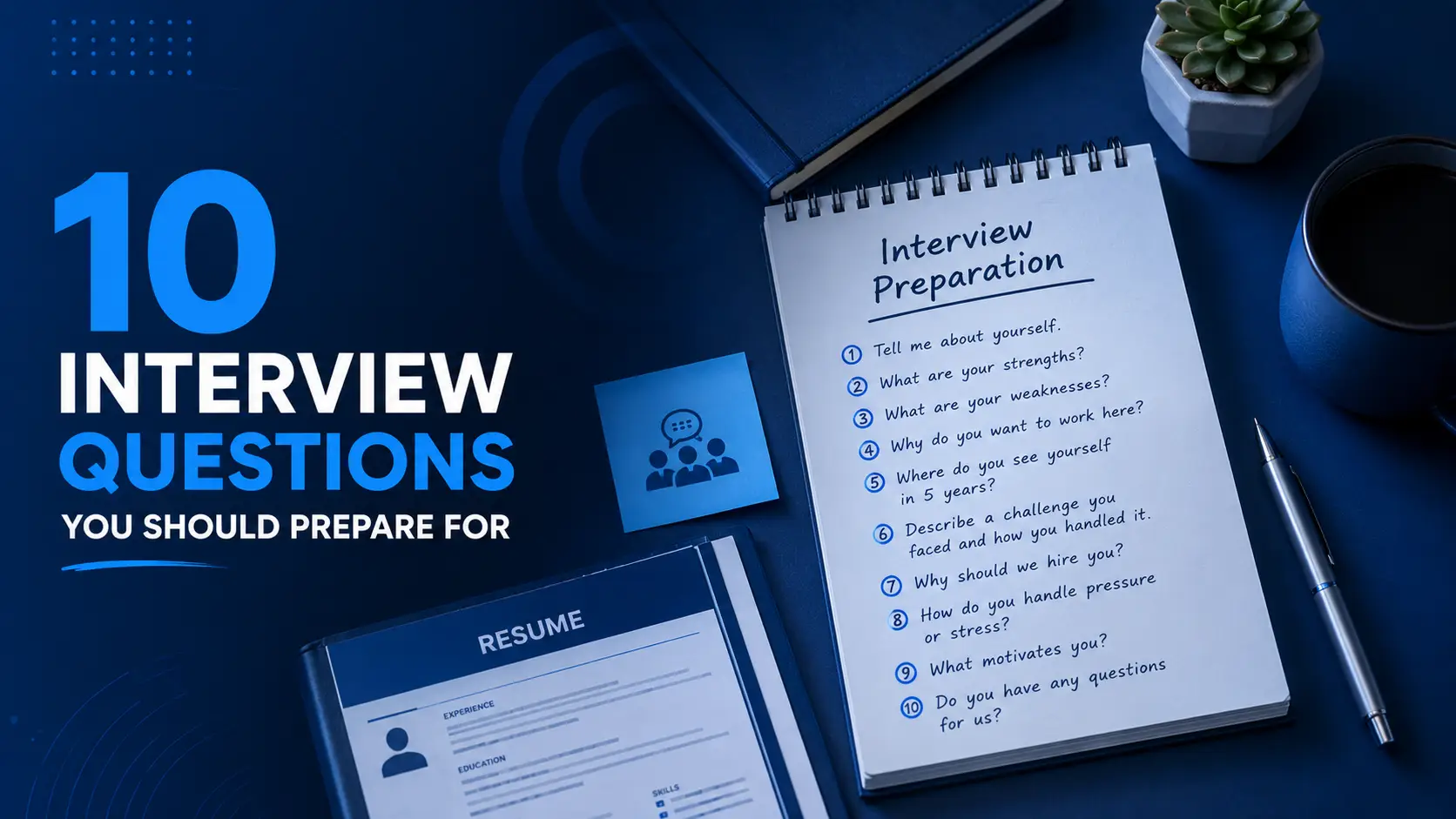
10 Interview Questions You Should Prepare For
Key Takeaways
- Ten questions come up in some form in nearly every interview. Preparing a structure for each one, rather than a memorized script, is what actually makes you sound confident in the room.
- The STAR method (Situation, Task, Action, Result) is the most reliable way to structure an answer that involves a real example from your work history.
- An interview is a two-way conversation. Coming with your own questions for the interviewer matters almost as much as answering theirs well.
You can't predict every question an interviewer will ask, but a small set of them shows up again and again across industries and roles. Preparing for these ten gives you a real advantage: not because you'll recite a script, but because you'll walk in with a clear structure for each answer instead of scrambling to build one on the spot.
Why Preparation Matters More Than Memorized Answers
Interviewers aren't grading you on eloquence. They're using each question to test something specific: your self-awareness, your fit with the role, your ability to handle a real situation. When coaching clients through interview prep alongside their resume, the pattern we see most often isn't a lack of experience, it's candidates who have great stories but haven't organized them into an answer an interviewer can follow.
That's what preparation actually buys you. Not a script to recite, but a structure to lean on so your best examples come out clearly under pressure.
10 Interview Questions to Prepare For
1. Tell me about yourself
This is almost always the opening question, and interviewers are really asking you to summarize your professional story in a way that connects your background to this specific role.
A reliable structure here is present, past, future: start with what you're doing now, briefly cover the experience that got you here, then connect it to why you want this job. Keep it to about a minute.
Example: "I'm currently a marketing coordinator managing social campaigns for a mid-sized retail brand. Before that, I worked in customer support, which taught me a lot about what actually matters to customers, and I've carried that into how I write campaign copy now. I'm looking for a role where I can take on more strategy, which is what drew me to this position."
2. What is your greatest strength?
The interviewer wants proof, not adjectives. They're testing whether you can back up a claim about yourself with a specific, believable example.
Pick one strength that's genuinely relevant to the job, then use the STAR method (Situation, Task, Action, Result) to walk through a real moment where it showed up.
Example: "One of my strongest skills is turning messy processes into something repeatable. At my last job, our reporting took each analyst about four hours a week to compile by hand [Situation/Task]. I built a shared template that pulled in the recurring data automatically [Action], which cut that down to under 30 minutes and became the standard across the team [Result]."
3. What is your greatest weakness?
This question tests self-awareness, not perfection. Interviewers want to see that you can name a real growth area and that you're actively doing something about it.
Avoid the two common traps: naming something so minor it sounds fake, or disguising a strength as a weakness. Pick something real, then describe the concrete step you've taken to improve it.
Example: "I used to avoid speaking up in larger meetings, even when I had something useful to add. I started deliberately preparing one or two points ahead of every meeting so I'd have something ready to contribute, and it's made a real difference in how comfortable I am now."
4. Why do you want to work here?
This one separates candidates who researched the company from those who didn't. A generic answer that could apply to any employer is an immediate red flag.
Point to something specific: a product, a recent initiative, a value the company has publicly stated, and connect it to your own goals or experience.
Example: "I've followed your expansion into the Southeast Asian market over the past year, and I'm particularly interested in how you're building out localized support teams. That kind of hands-on, region-specific approach is exactly the kind of work I want to be doing next."
5. Why should we hire you?
Interviewers are asking you to make the case for yourself directly: not just that you can do the job, but that you'd do it well and fit the team. For a deeper breakdown, see our full guide on how to answer "Why should we hire you?".
Cover three things briefly: you can do the work, you'll fit the team and culture, and you bring something that sets you apart from other candidates.
Example: "I have five years of experience solving exactly the kind of scaling problems this role is focused on, and I've done it in fast-moving environments similar to yours. Beyond the technical fit, I care a lot about mentoring, and I know this team is growing, so I'd bring that alongside the day-to-day work."
6. Tell me about a challenge or conflict you faced at work
This tests how you handle friction professionally. Interviewers aren't looking for a conflict-free history, they're looking for evidence you can navigate one without losing your composure.
STAR works well here too. Spend more time on the resolution than on the conflict itself, and mention what you'd do differently if it came up again.
Example: "A teammate and I disagreed on the direction for a client proposal [Situation]. I needed us aligned before the deadline [Task], so I set up a short call to understand his reasoning instead of pushing my version over email [Action]. We ended up combining both approaches, and the client picked it over two competing agencies [Result]."
7. Tell me about a time you demonstrated leadership
You don't need a management title to answer this well. Interviewers want to see initiative: a moment where you stepped up, organized something, or moved a group toward a result.
Use STAR again, and make sure the "result" section is concrete. Vague leadership stories are forgettable; specific ones stick.
Example: "Our team's biggest client presentation was falling behind schedule with two days left [Situation]. As the most senior person available, I took the initiative to redistribute tasks based on who had bandwidth [Action], and we delivered the presentation a day early with time to rehearse [Result]. We won the renewal."
8. Where do you see yourself in five years?
This question checks two things at once: whether you've thought realistically about your career, and whether this role actually fits into that path.
Be specific but grounded. You don't need an exact title, just a believable direction that this job would plausibly lead toward.
Example: "In five years, I'd like to be leading a small team focused on the kind of client strategy work this role touches on. I know that takes time to build toward, and I see this position as a strong step in that direction."
9. Why are you leaving your current job?
Interviewers are listening for how you talk about your past employer as much as the actual reason. Negativity here is one of the fastest ways to raise a red flag.
Keep it forward-looking. If you were laid off, say so plainly and move on; there's no need to over-explain.
Example: "I've learned a lot in my current role, but I've reached the point where the growth opportunities are limited. I'm looking for a position with more room to take on strategic work, which is what drew me to this opening."
10. What are your salary expectations?
This one is practical, but it still matters how you handle it. Interviewers want to know you've done your research and that your expectations are realistic for the role and market.
Research the going rate for the role and location beforehand, then give a range rather than a single number, with the lower end near what you're actually hoping for.
Example: "Based on my research and experience level, I'm looking at a range of $65,000 to $75,000, though I'm open to discussing the full compensation package."
Questions to Ask the Interviewer
An interview isn't just them evaluating you. It's also your chance to find out whether the role and company are actually right for you, and asking good questions signals that you've been paying attention throughout the conversation.
A few that consistently work well:
- "How would you describe success in this role after the first six months?"
- "What does the team's current biggest challenge look like?"
- "What do you personally enjoy most about working here?"
- "What's the next step in the process, and when should I expect to hear back?"
Avoid asking about salary, benefits, or vacation time before the employer brings it up. Save those for once an offer is on the table.
Frequently Asked Questions
What is the STAR method?
STAR stands for Situation, Task, Action, and Result. It's a framework for structuring answers to behavioral questions: briefly set up the context, explain what you needed to do, describe the specific action you took, and share the measurable outcome.
How many interview questions should I actually prepare for?
There's no fixed number, but having 5 to 10 solid stories ready to adapt to different questions covers most interviews well. Rather than memorizing answers to dozens of possible questions, prepare a handful of strong examples you can shape to fit whatever's asked.
Is it okay to pause before answering a question?
Yes. Taking a few seconds to organize your thoughts before responding, especially for a behavioral question, is completely normal and often reads as thoughtful rather than unprepared. Interviewers generally respect a brief pause over a rushed, disorganized answer.
What if I don't have a perfect example for a question?
Use the closest example you have and be honest about the scale. A smaller but genuine story, clearly structured with STAR, will always land better than a stretched or exaggerated one.
Should I prepare differently for a phone interview versus an in-person one?
The content of your answers stays the same, but for a phone interview, keep notes nearby since the interviewer can't see them, and speak slightly slower than feels natural since you lose the visual cues of a normal conversation.
How do I answer "why should we hire you" without sounding arrogant?
Focus on specific evidence rather than general claims. Instead of saying you're the best candidate, point to concrete experience and results that map directly to what the job requires, and let the specifics make the case for you.
Once your interview answers are ready, it's worth double-checking that your resume is what actually got you the interview in the first place. Run it through our free ATS Resume Checker to catch formatting or keyword issues, or see our resume writing service if you'd like a professional to build it with you from scratch.